Learn how GEO for hotels works and how to get your property recommended by ChatGPT, Perplexity and other AI search tools in 2026.




A guest is planning a weekend in Lisbon.
Five years ago, they would have opened ten tabs. Booking.com, TripAdvisor, a few hotel websites, maybe a Reddit thread. Compared prices. Cross-checked reviews. Eventually picked something.
Today, they open ChatGPT and type one line.
"Suggest a boutique hotel in Lisbon for two adults, walking distance from Alfama, under 250 euros a night."
In four seconds, they get three property recommendations. By name. With reasons.
If your hotel is one of those three, you just won a booking without paying a single rupee in OTA commission. If your hotel is not, you do not even know the conversation happened.
This is the new visibility problem in hospitality. And most hoteliers have no idea it exists yet.
GEO stands for Generative Engine Optimization.
It is the practice of structuring your hotel's online presence so that AI tools like ChatGPT, Perplexity, Google Gemini, and Claude can read it, trust it, and recommend it when a traveler asks where to stay.
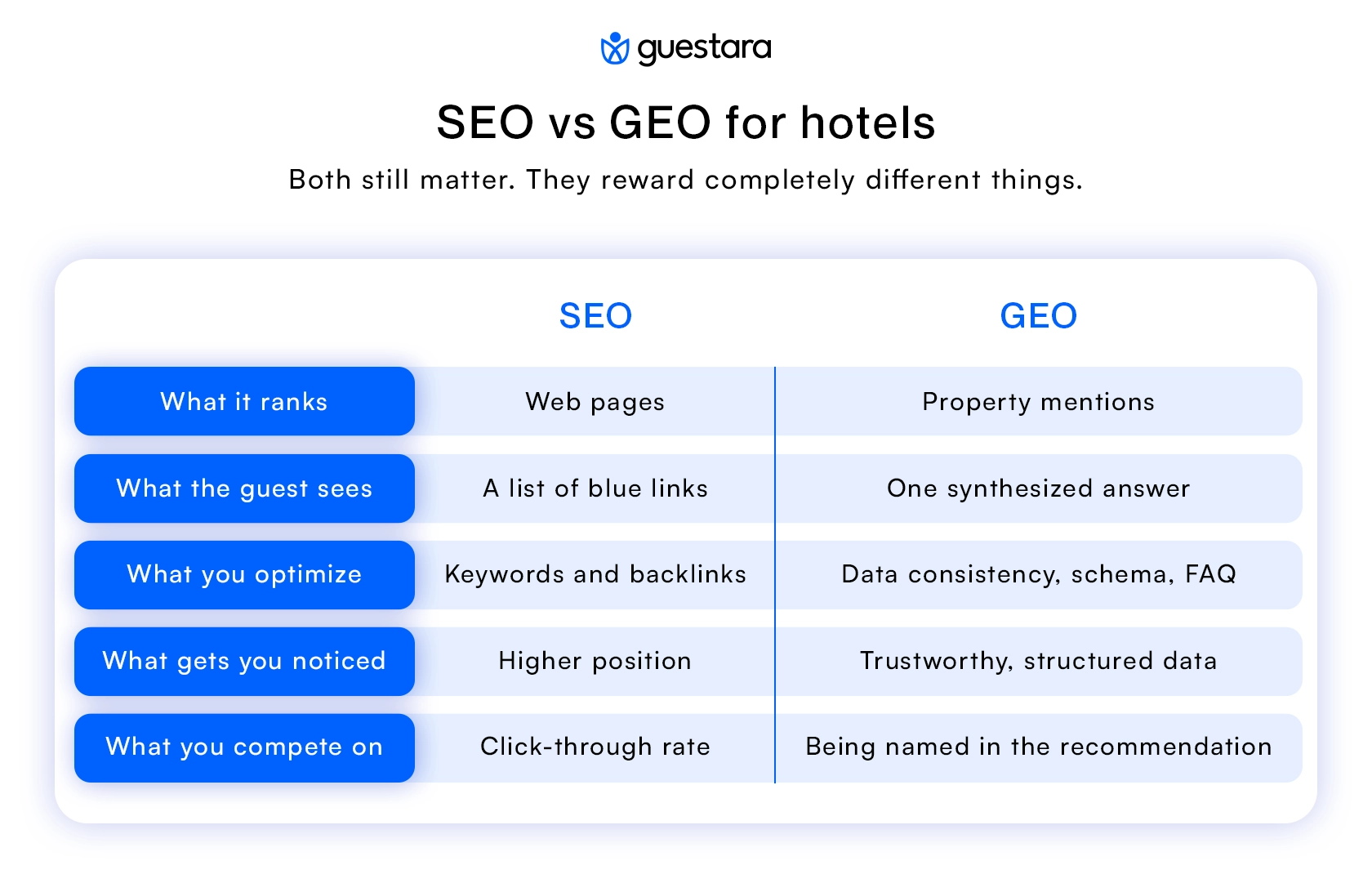
SEO gets your hotel ranked in a list of blue links. GEO gets your hotel mentioned by name inside a one-paragraph answer.
These are completely different games.
In SEO, the traveler still has to click through and compare. In GEO, the traveler often skips comparison entirely. They take the AI's recommendation and book.
That shift changes who wins.
A few numbers explain why this is no longer a 2027 problem.
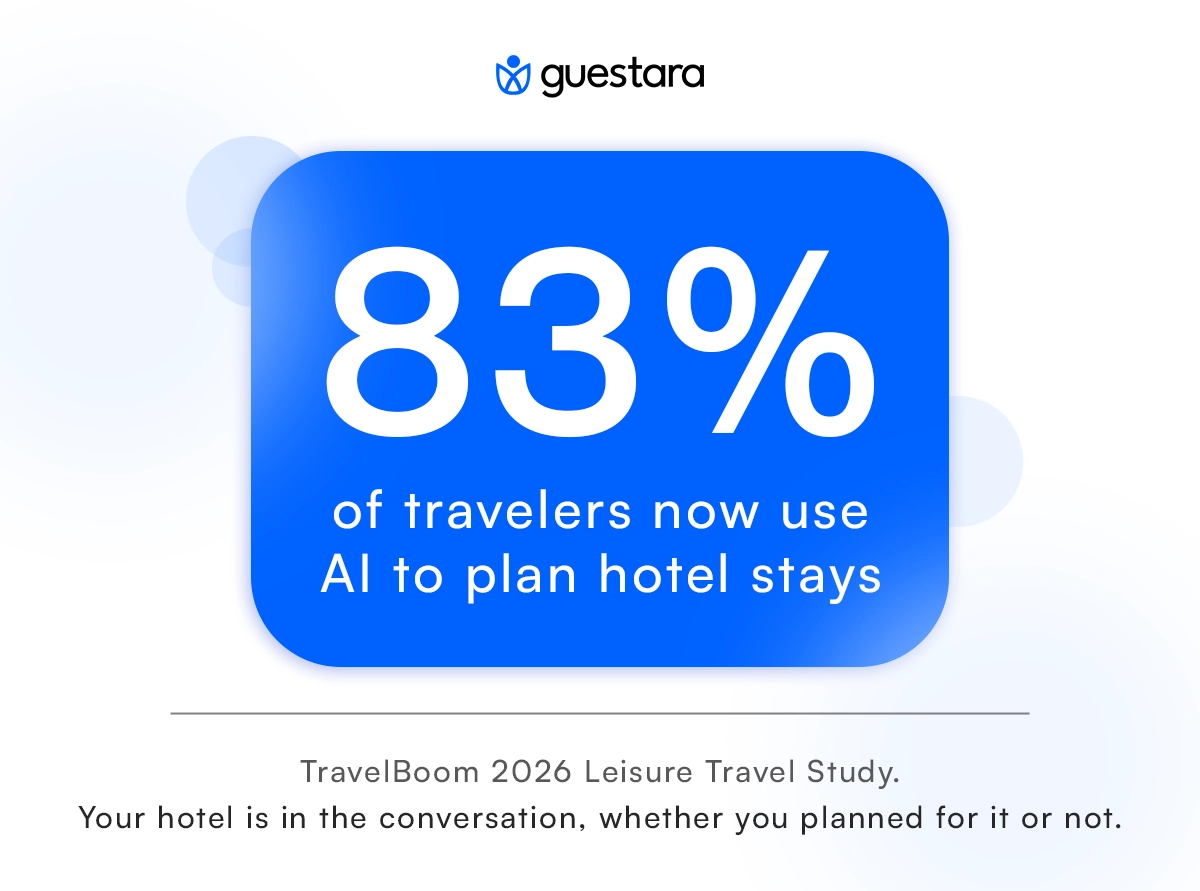
According to TravelBoom's 2026 Leisure Travel Study, 83% of travelers either use or want to use AI for trip planning. Operto reports that 40% of travelers already use AI tools for trip planning and booking, and 70% of hotel bookings now involve AI-driven recommendations at some point in the journey.
Gartner predicts traditional search engine volume will drop 25% by 2026 as more queries shift to generative engines.
ChatGPT now serves more than 800 million weekly active users, making it one of the fastest-growing consumer products in history.
Now think about what that means for your direct booking funnel.
For the last decade, the path to your hotel website looked like this:
Google search → 10 organic results → traveler clicks → traveler compares → traveler books.
The new path looks like this:
ChatGPT prompt → one synthesized answer mentioning three hotels → traveler picks one → traveler books.
If your hotel is not in the answer, the traveler never sees you. There is no second page to scroll to. There is no listing to click. You are simply absent from the conversation.
Here is what most hoteliers get wrong about GEO.
They assume AI tools work like Google. Better keywords, better ranking. That is not how generative engines think.
When a traveler asks ChatGPT for a hotel recommendation, the model is doing something closer to what a smart concierge does. It is pulling fragments of information from many places and trying to build a confident picture of your property.
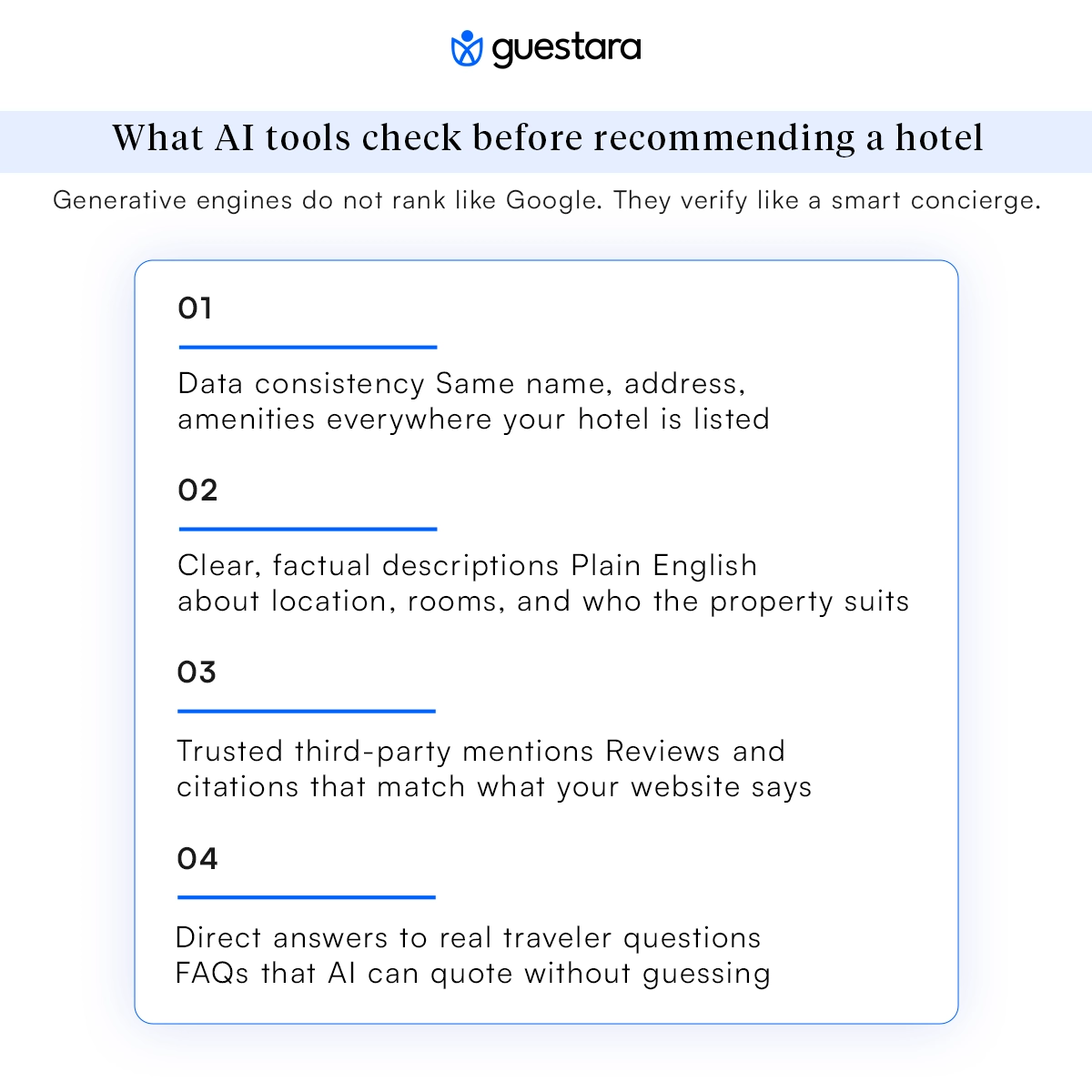
Here are the four questions every AI tool runs through before it recommends your hotel.
The AI cross-checks your hotel name, address, phone, website, and category across your own site, Booking.com, Expedia, TripAdvisor, Google Business Profile, and a dozen other sources.
If your website says you have a rooftop pool and Booking.com does not mention it, the model's confidence drops.
When confidence drops, the AI does what it is designed to do. It avoids you to prevent generating a wrong answer. This is called hallucination avoidance. The model would rather recommend a hotel it is sure about than risk being wrong about yours.
Generative models do not read marketing copy the way humans do.
They scan for facts. Location. Neighborhood. Room types. Amenity list. Who the property is best for. Price band. Distance from major landmarks.
A line like "an unforgettable urban sanctuary where memories are crafted" tells the AI nothing it can use. A line like "32-room boutique hotel in Bandra West, Mumbai, with rooftop bar, three restaurant options, and 4-minute walk from Bandstand" tells the AI everything.
One of these gets recommended. The other gets skipped.
AI tools weight independent sources more heavily than your own website.
If your hotel website says you are family-friendly but reviews on TripAdvisor and Booking.com mention noise, late-night events, and adult-only vibes, the AI trusts the reviews.
This is why review content quietly matters more than most hoteliers realize. When dozens of guests describe your property as "perfect for couples," the AI learns to surface you for romantic getaway queries. When reviews repeatedly mention "great for remote work," you start showing up in digital nomad recommendations.
Your guests' words become your GEO strategy, whether you planned it that way or not.
Generative models love clean Q&A content.
When your site has clear, factual answers to questions like "what time is check-in," "is parking free," "how far is the airport," "is the pool heated," the AI can pull those answers directly into its response.
Hotels that hide this information behind PDFs, contact forms, or vague marketing pages get filtered out. Not because they are bad hotels. Because the AI cannot quote them confidently.
Now that you know how the engines think, here is what you actually do.
This is the part most articles skip. They explain the theory and stop. Below is the operating checklist.
Pull up your listings on Booking.com, Expedia, TripAdvisor, Google Business Profile, Hotels.com, and your own website.
Check three things on each:
Most hotels fail this check on day one. One platform says "free WiFi," another says nothing about WiFi at all. One platform lists 28 rooms, another lists 32. These small inconsistencies tell the AI your data is unreliable.
Fix the gaps. Make the lists match. Audit this once a quarter.
Open your hotel's About page. Read it out loud.
If the first paragraph contains words like "elevated," "curated," "immersive," "bespoke," or "journey," delete it.
Replace it with the actual facts. Where are you. How many rooms. What kind of property. What is nearby. Who is it for.
Then check every page. Room descriptions, amenity lists, location pages, FAQ sections. The goal is not to sound less premium. The goal is to make your facts extractable.
A boutique hotel in Udaipur should have its location, distance from City Palace, room count, restaurant offerings, and pool details visible in the first 100 words of the relevant pages. Not buried below a hero image with a slogan.
This is the single highest-leverage move most hotels can make in a weekend.
Sit with your front desk team for an hour. Ask them what guests ask twenty times a day. Write down every question.
Then put those questions and their direct answers on your website, structured as a proper FAQ.
Sample questions every hotel website should answer:
Generative engines pull directly from FAQ-formatted content. It is the easiest content for them to verify and quote.
This is the technical layer most independent hotels skip.
Schema is code that sits on your website and tells AI tools exactly what your property is. The Hotel schema, LocalBusiness schema, and FAQPage schema together give the engines a clean, machine-readable map of your property.
You do not need to be a developer to do this. Most modern CMS platforms have schema plugins. If your website is on WordPress, plugins like Rank Math or Yoast handle the basics. If you are on a hotel-specific CMS, ask your provider whether they output Hotel schema by default.
Once schema is in place, AI tools no longer have to guess what your page is about. They are told.
Generative engines weight authority sources heavily.
A mention of your hotel in a Condé Nast Traveler list, a Skift article, a destination blog with strong domain authority, or a regional tourism board page tells the AI your property is real and credible.
You do not need a PR firm for this. You need to do three things:
Even small mentions compound over time. The AI is not looking for one massive feature. It is looking for repeated, consistent reinforcement across sources.
This is the easiest step and the one most hoteliers never do.
Open ChatGPT, Perplexity, and Gemini. Ask each one:
"Recommend a hotel in [your city] for [your typical guest type]."
Then ask: "Tell me about [your hotel name]."
What the AI says back is the truth of your current GEO position. If it cannot find you, you have a discoverability problem. If it gets facts wrong, you have a consistency problem. If it describes you generically, you have a differentiation problem.
Run this test once a month. Track what changes.
Imagine two boutique hotels in Goa.
Hotel A has a beautiful website, lots of marketing copy, and OTA listings that mostly match. The owner has heard of GEO but has not done anything about it. When you ask ChatGPT for boutique hotels in North Goa for couples, Hotel A is not mentioned.
Hotel B has spent two months tightening data consistency, rewriting their website with factual descriptions, building a proper FAQ section, adding Hotel and FAQPage schema, and getting cited in two travel blogs and the state tourism site. When you ask ChatGPT for boutique hotels in North Goa for couples, Hotel B is in the recommendation.
Both hotels are equally good. Both have the same room rates. The only difference is that one is readable to AI and the other is not.
This is the gap that will define the next decade of hotel marketing.
Most of what makes GEO work is content and data work. But two parts of the equation directly intersect with how Guestara is built.
Guestara's Guest App is a web-based digital guidebook that holds all the structured property information that AI tools need to read. WiFi, house rules, check-in times, parking, pool hours, amenity lists, local recommendations, and policies all sit in one clean, indexable place. When you keep the Guest App updated, you are also keeping the source data clean for AI tools to learn from.
The AI Chatbot adds the other half. It sits on your website and is trained on your property's actual data. When a guest asks a question, it answers from your verified information instead of from a marketing page. That same structured Q&A pattern, where real questions get real answers, is exactly what generative engines pull from when they decide which hotels to recommend.
You still have to do the data hygiene, schema work, and third-party authority building yourself. But the property-side content layer, the part most hotels handle through scattered PDFs and out-of-date pages, gets unified.
If you read all of this and feel behind, do not panic. Most hotels are.
Here is the 90-day plan.
Month 1. Audit your data consistency across Booking.com, Expedia, TripAdvisor, Google Business Profile, and your own website. Fix every mismatch. Rewrite your About page and home page in factual, extractable English.
Month 2. Build a 15-question FAQ section based on what your front desk hears every day. Add Hotel schema, LocalBusiness schema, and FAQPage schema to your site. If you do not have a developer, use a CMS plugin or ask your hotel website provider.
Month 3. Pitch your property to two travel bloggers covering your destination. Get listed on your regional tourism board. Run the AI visibility test on ChatGPT, Perplexity, and Gemini. Note what you see.
By month four, you should already be showing up in AI answers you were invisible to in month one.


Learn how GEO for hotels works and how to get your property recommended by ChatGPT, Perplexity and other AI search tools in 2026.
A guest is planning a weekend in Lisbon.
Five years ago, they would have opened ten tabs. Booking.com, TripAdvisor, a few hotel websites, maybe a Reddit thread. Compared prices. Cross-checked reviews. Eventually picked something.
Today, they open ChatGPT and type one line.
"Suggest a boutique hotel in Lisbon for two adults, walking distance from Alfama, under 250 euros a night."
In four seconds, they get three property recommendations. By name. With reasons.
If your hotel is one of those three, you just won a booking without paying a single rupee in OTA commission. If your hotel is not, you do not even know the conversation happened.
This is the new visibility problem in hospitality. And most hoteliers have no idea it exists yet.
GEO stands for Generative Engine Optimization.
It is the practice of structuring your hotel's online presence so that AI tools like ChatGPT, Perplexity, Google Gemini, and Claude can read it, trust it, and recommend it when a traveler asks where to stay.
SEO gets your hotel ranked in a list of blue links. GEO gets your hotel mentioned by name inside a one-paragraph answer.
These are completely different games.
In SEO, the traveler still has to click through and compare. In GEO, the traveler often skips comparison entirely. They take the AI's recommendation and book.
That shift changes who wins.
A few numbers explain why this is no longer a 2027 problem.
According to TravelBoom's 2026 Leisure Travel Study, 83% of travelers either use or want to use AI for trip planning. Operto reports that 40% of travelers already use AI tools for trip planning and booking, and 70% of hotel bookings now involve AI-driven recommendations at some point in the journey.
Gartner predicts traditional search engine volume will drop 25% by 2026 as more queries shift to generative engines.
ChatGPT now serves more than 800 million weekly active users, making it one of the fastest-growing consumer products in history.
Now think about what that means for your direct booking funnel.
For the last decade, the path to your hotel website looked like this:
Google search → 10 organic results → traveler clicks → traveler compares → traveler books.
The new path looks like this:
ChatGPT prompt → one synthesized answer mentioning three hotels → traveler picks one → traveler books.
If your hotel is not in the answer, the traveler never sees you. There is no second page to scroll to. There is no listing to click. You are simply absent from the conversation.
Here is what most hoteliers get wrong about GEO.
They assume AI tools work like Google. Better keywords, better ranking. That is not how generative engines think.
When a traveler asks ChatGPT for a hotel recommendation, the model is doing something closer to what a smart concierge does. It is pulling fragments of information from many places and trying to build a confident picture of your property.
Here are the four questions every AI tool runs through before it recommends your hotel.
The AI cross-checks your hotel name, address, phone, website, and category across your own site, Booking.com, Expedia, TripAdvisor, Google Business Profile, and a dozen other sources.
If your website says you have a rooftop pool and Booking.com does not mention it, the model's confidence drops.
When confidence drops, the AI does what it is designed to do. It avoids you to prevent generating a wrong answer. This is called hallucination avoidance. The model would rather recommend a hotel it is sure about than risk being wrong about yours.
Generative models do not read marketing copy the way humans do.
They scan for facts. Location. Neighborhood. Room types. Amenity list. Who the property is best for. Price band. Distance from major landmarks.
A line like "an unforgettable urban sanctuary where memories are crafted" tells the AI nothing it can use. A line like "32-room boutique hotel in Bandra West, Mumbai, with rooftop bar, three restaurant options, and 4-minute walk from Bandstand" tells the AI everything.
One of these gets recommended. The other gets skipped.
AI tools weight independent sources more heavily than your own website.
If your hotel website says you are family-friendly but reviews on TripAdvisor and Booking.com mention noise, late-night events, and adult-only vibes, the AI trusts the reviews.
This is why review content quietly matters more than most hoteliers realize. When dozens of guests describe your property as "perfect for couples," the AI learns to surface you for romantic getaway queries. When reviews repeatedly mention "great for remote work," you start showing up in digital nomad recommendations.
Your guests' words become your GEO strategy, whether you planned it that way or not.
Generative models love clean Q&A content.
When your site has clear, factual answers to questions like "what time is check-in," "is parking free," "how far is the airport," "is the pool heated," the AI can pull those answers directly into its response.
Hotels that hide this information behind PDFs, contact forms, or vague marketing pages get filtered out. Not because they are bad hotels. Because the AI cannot quote them confidently.
Now that you know how the engines think, here is what you actually do.
This is the part most articles skip. They explain the theory and stop. Below is the operating checklist.
Pull up your listings on Booking.com, Expedia, TripAdvisor, Google Business Profile, Hotels.com, and your own website.
Check three things on each:
Most hotels fail this check on day one. One platform says "free WiFi," another says nothing about WiFi at all. One platform lists 28 rooms, another lists 32. These small inconsistencies tell the AI your data is unreliable.
Fix the gaps. Make the lists match. Audit this once a quarter.
Open your hotel's About page. Read it out loud.
If the first paragraph contains words like "elevated," "curated," "immersive," "bespoke," or "journey," delete it.
Replace it with the actual facts. Where are you. How many rooms. What kind of property. What is nearby. Who is it for.
Then check every page. Room descriptions, amenity lists, location pages, FAQ sections. The goal is not to sound less premium. The goal is to make your facts extractable.
A boutique hotel in Udaipur should have its location, distance from City Palace, room count, restaurant offerings, and pool details visible in the first 100 words of the relevant pages. Not buried below a hero image with a slogan.
This is the single highest-leverage move most hotels can make in a weekend.
Sit with your front desk team for an hour. Ask them what guests ask twenty times a day. Write down every question.
Then put those questions and their direct answers on your website, structured as a proper FAQ.
Sample questions every hotel website should answer:
Generative engines pull directly from FAQ-formatted content. It is the easiest content for them to verify and quote.
This is the technical layer most independent hotels skip.
Schema is code that sits on your website and tells AI tools exactly what your property is. The Hotel schema, LocalBusiness schema, and FAQPage schema together give the engines a clean, machine-readable map of your property.
You do not need to be a developer to do this. Most modern CMS platforms have schema plugins. If your website is on WordPress, plugins like Rank Math or Yoast handle the basics. If you are on a hotel-specific CMS, ask your provider whether they output Hotel schema by default.
Once schema is in place, AI tools no longer have to guess what your page is about. They are told.
Generative engines weight authority sources heavily.
A mention of your hotel in a Condé Nast Traveler list, a Skift article, a destination blog with strong domain authority, or a regional tourism board page tells the AI your property is real and credible.
You do not need a PR firm for this. You need to do three things:
Even small mentions compound over time. The AI is not looking for one massive feature. It is looking for repeated, consistent reinforcement across sources.
This is the easiest step and the one most hoteliers never do.
Open ChatGPT, Perplexity, and Gemini. Ask each one:
"Recommend a hotel in [your city] for [your typical guest type]."
Then ask: "Tell me about [your hotel name]."
What the AI says back is the truth of your current GEO position. If it cannot find you, you have a discoverability problem. If it gets facts wrong, you have a consistency problem. If it describes you generically, you have a differentiation problem.
Run this test once a month. Track what changes.
Imagine two boutique hotels in Goa.
Hotel A has a beautiful website, lots of marketing copy, and OTA listings that mostly match. The owner has heard of GEO but has not done anything about it. When you ask ChatGPT for boutique hotels in North Goa for couples, Hotel A is not mentioned.
Hotel B has spent two months tightening data consistency, rewriting their website with factual descriptions, building a proper FAQ section, adding Hotel and FAQPage schema, and getting cited in two travel blogs and the state tourism site. When you ask ChatGPT for boutique hotels in North Goa for couples, Hotel B is in the recommendation.
Both hotels are equally good. Both have the same room rates. The only difference is that one is readable to AI and the other is not.
This is the gap that will define the next decade of hotel marketing.
Most of what makes GEO work is content and data work. But two parts of the equation directly intersect with how Guestara is built.
Guestara's Guest App is a web-based digital guidebook that holds all the structured property information that AI tools need to read. WiFi, house rules, check-in times, parking, pool hours, amenity lists, local recommendations, and policies all sit in one clean, indexable place. When you keep the Guest App updated, you are also keeping the source data clean for AI tools to learn from.
The AI Chatbot adds the other half. It sits on your website and is trained on your property's actual data. When a guest asks a question, it answers from your verified information instead of from a marketing page. That same structured Q&A pattern, where real questions get real answers, is exactly what generative engines pull from when they decide which hotels to recommend.
You still have to do the data hygiene, schema work, and third-party authority building yourself. But the property-side content layer, the part most hotels handle through scattered PDFs and out-of-date pages, gets unified.
If you read all of this and feel behind, do not panic. Most hotels are.
Here is the 90-day plan.
Month 1. Audit your data consistency across Booking.com, Expedia, TripAdvisor, Google Business Profile, and your own website. Fix every mismatch. Rewrite your About page and home page in factual, extractable English.
Month 2. Build a 15-question FAQ section based on what your front desk hears every day. Add Hotel schema, LocalBusiness schema, and FAQPage schema to your site. If you do not have a developer, use a CMS plugin or ask your hotel website provider.
Month 3. Pitch your property to two travel bloggers covering your destination. Get listed on your regional tourism board. Run the AI visibility test on ChatGPT, Perplexity, and Gemini. Note what you see.
By month four, you should already be showing up in AI answers you were invisible to in month one.
GEO stands for Generative Engine Optimization. It is the practice of structuring a hotel's online content and data so AI tools like ChatGPT, Perplexity, and Gemini can understand the property and recommend it when travelers ask where to stay.
SEO helps your hotel rank higher in a list of search results. GEO helps your hotel get recommended by name inside a single AI-generated answer. SEO drives clicks. GEO drives mentions. Both matter, but they reward different things.
Yes, often more easily than in traditional SEO. AI tools weight verified, structured property data over brand size. An independent hotel with consistent listings, clean schema, and strong reviews can appear alongside chain hotels in AI shortlists.
Most hotels start seeing changes in AI visibility within 60 to 90 days of fixing data consistency, adding schema, and improving FAQ content. Authority building from third-party citations takes longer, usually 6 months or more.
No. Most of the early work is data hygiene, content rewrites, and schema setup, which an in-house marketing person or website provider can handle. Specialist help becomes useful once you have the basics in place and want to scale authority building.
We work closely with the industry leaders to offer seamless solutions




We’re here to help your whole team stay ahead of the curve as you grow.

Get up and running quickly with a personalized onboarding plan

Connect with real people who really get it, 24/7

Checkout our vast library of free resources, templates and more
There's only so much we can say — so let us show you! Schedule a demo today and reach your business goals.


.webp)
.png)

