Biometric hotel check-in is real but narrow. Here is where AI and biometric check-in runs today, what the rules broadly require, and what ships instead.




Yes, hotels will use biometric check-in, and the honest answer is that it stays narrow. It is running today in a small set of properties, it is optional nearly everywhere it is legal, and it has been three years away from mainstream for about six years running.
Meanwhile a different technology quietly took the arrival. AI ID check-in reads the guest's passport or licence, fills the registration form, and finishes in about 30 seconds. No face stored, no enrollment, no consent regime. It shipped because it asked less of everybody.
That is the gap worth understanding. The industry conversation is about faces. The industry deployment is about documents.
This guide covers what biometric check-in actually is, where it genuinely runs today, why guest-facing adoption keeps stalling, what the rules broadly require, and where hotel arrival goes from here.
Biometric hotel check-in verifies a guest by matching a physical trait against a stored record. A face, a fingerprint or an iris. The system confirms the person standing there is the person who booked.
A biometric is a measurement of the body that is unique and permanent. Face geometry, fingerprints, iris patterns, voiceprints and hand geometry all qualify.
What does not qualify matters just as much. A photograph of a passport is not a biometric. Neither is a name, a booking reference or a signature. The distinction is whether the system measures the person or reads a document about them.
Permanence is why the law treats biometrics differently from other data. A leaked password gets changed in a minute. A leaked fingerprint is leaked forever.
An AI ID scan reads the document. A biometric scan reads the guest.
In an AI ID check-in, the guest photographs their passport or driving licence, AI extracts the fields, and the registration form fills itself. The output is text in a booking record. Nothing about the guest's body is measured or stored.
In a biometric check-in, the guest enrolls once by having their face or fingerprint captured, the system creates a mathematical template, and every later check compares a live capture against that template. The output is a permanent record of a physical trait.
Two different technologies with two different risk profiles, routinely described with the same marketing language.
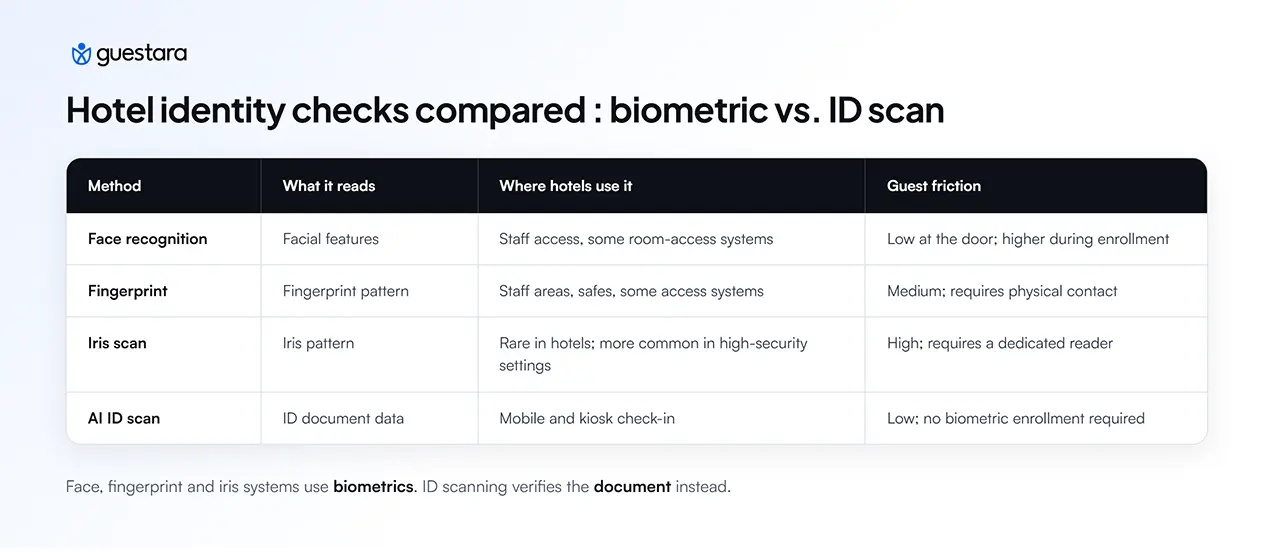
Mostly for staff, not guests. The most widespread biometric deployment in hotels is facial recognition controlling employee access to back-of-house areas, which involves a known population, a controlled environment and far fewer consent obligations than a guest-facing system.
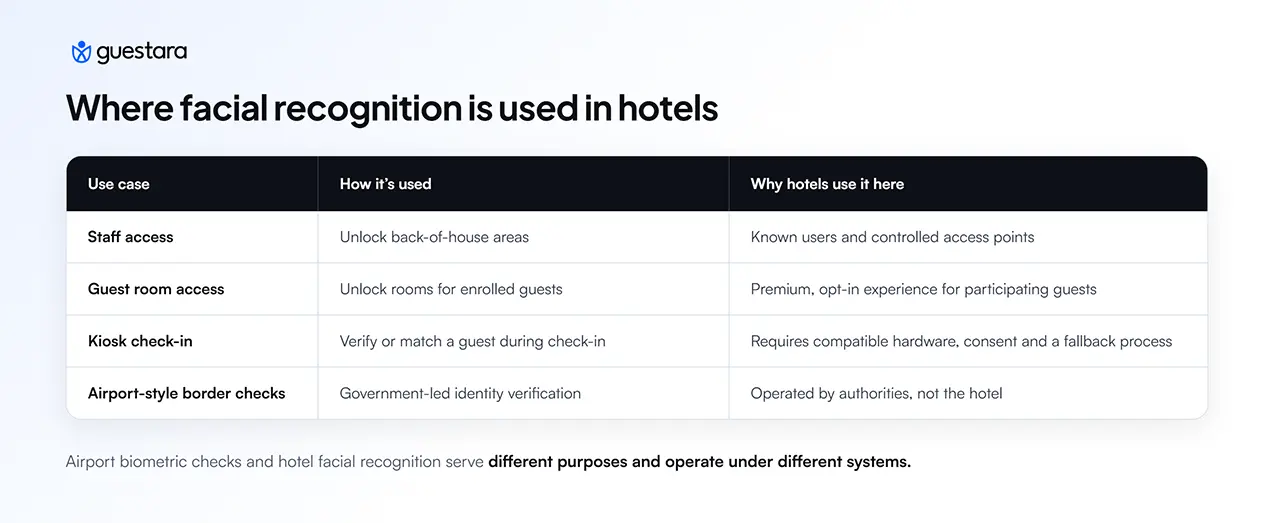
That last row causes more confusion than any other. A guest who cleared a border with a face scan often assumes hotels have the same capability. Hotels do not. The airport system belongs to a government, runs on a legal basis no private business has, and shares nothing downstream. For arrival technology a hotel can actually operate, self-service kiosk and tablet registration is the realistic equivalent.
Guests meet biometric check-in in three places. China, where it is legally permitted and has real scale. A small number of luxury properties offering opt-in face access to rooms, usually alongside smart locks and digital keys. And a handful of government-led arrival programmes in specific cities.
Outside those, a guest travelling for a year would rarely encounter a hotel that scans their face to check them in.
Hotel biometrics has produced a decade of pilots and very few rollouts. Vendors have long described the sector as learning and waiting rather than buying, and the demonstrations that get attention at industry conferences are usually experiments rather than production systems.
A pilot proves the technology works. A rollout requires the consent flow, the fallback lane, the retention policy, the staff training and the legal review to all work too. That second list is where most projects stop.
Three things cap guest-facing biometric check-in, and none of them is the technology. The technology works. Consent, the permanent fallback and the cost against a narrow benefit are what hold it back.
Almost everywhere biometric check-in is legal, it requires the guest's explicit agreement. A hotel cannot make a face scan a condition of arrival.
That single fact defines the ceiling. An opt-in system serves only the guests who opt in, so it is a parallel lane rather than a replacement process. Whatever share of your arrivals says no still needs the original process, staffed and running.
Because a share of every arrival list cannot or will not enroll, and that share never reaches zero.
Guests who decline. Guests whose enrollment did not complete before arrival. Children on a family booking. Group bookings where one person booked for four. Guests with accessibility needs the capture step does not accommodate.
So biometric check-in does not remove the front desk. It adds a lane beside it. Any business case built on removing desk headcount is built on a number that does not arrive.
Here is the part the category rarely says out loud. Biometric check-in is competing against AI ID check-in, not against a paper form.
The costs are real: capture hardware, an enrollment flow, consent capture and storage, a written retention and deletion policy, and legal review in every jurisdiction you operate in. The benefit is shaving seconds off an arrival that already completes in about 30 seconds without any of it.
For a large chain with a loyalty base and repeat guests across properties, that maths can work. For an independent hotel, it rarely does.
Biometric data is treated as a special category almost everywhere. In practice that means explicit consent, a stated purpose, a limit on how long it is kept, and in some places a duty to tell people it is happening.
This section is a survey of what the rules broadly require. It is not a compliance procedure, and no hotel should act on it without its own legal advice.
The EU AI Act now has teeth on a published schedule. Transparency obligations applied from 2 August 2026, requiring that people are informed when they are subject to biometric categorisation or emotion recognition systems. The high-risk rules that cover biometrics apply from 2 December 2027, a date set by the Digital Omnibus regulation that entered into force on 27 July 2026. Prohibited practices have been enforceable since February 2025 and carry penalties up to 35 million euro or 7 percent of global turnover. The European Commission's regulatory framework page carries the current timeline.
One nuance gets misreported constantly. The Act's ban on real-time remote biometric identification targets law enforcement use in publicly accessible spaces. It does not prohibit a hotel from offering a consented face check-in to a guest who asked for it. Those are different things and conflating them produces bad advice in both directions.
The United States has no federal biometric law, so exposure is set state by state.
Illinois is the outlier and the reason biometric projects get legal review. Its Biometric Information Privacy Act is the only US biometric law that lets an individual sue a company directly, with damages of 1,000 dollars per negligent violation and 5,000 dollars per intentional one, plus fees. It requires written notice and a signed release before collection, and a published retention and destruction policy. The ACLU of Illinois summary is a readable starting point.
New York City takes a different route, requiring commercial establishments that collect biometric identifiers from customers to post clear signage at the entrance.
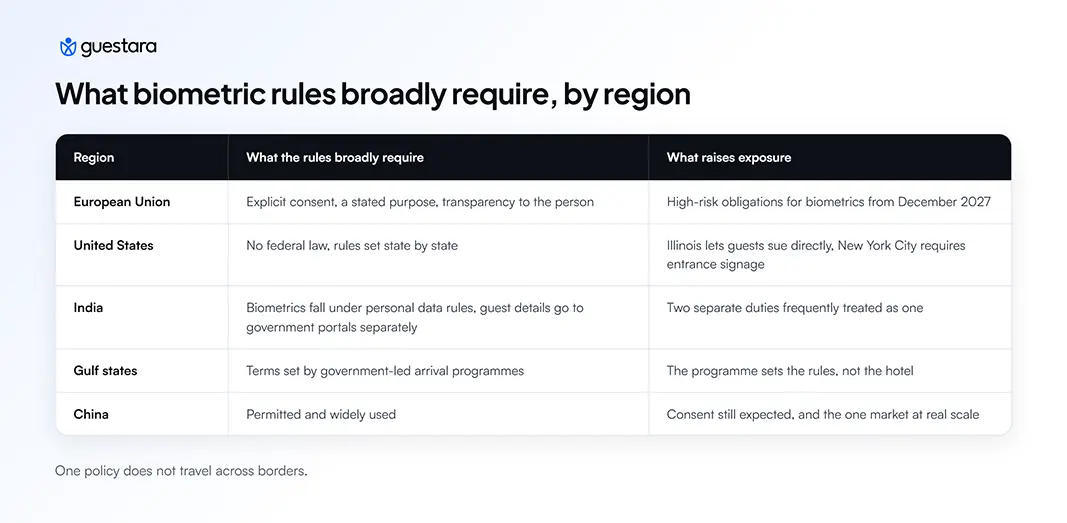
Government-led programmes are worth watching separately, because they set terms a hotel joins rather than writes. Dubai's citywide contactless hotel check-in system is the clearest current example of a city defining the arrival standard for every property in it.
The mechanics of verifying a guest without retaining their face, meaning templates rather than images, on-device matching and documented deletion, are a subject of their own and sit outside an awareness guide. That is a separate post in this cluster.
AI ID check-in reads the guest's identity document rather than the guest. The guest opens a link, photographs a passport or driving licence, AI extracts the fields, and the registration form fills itself.
The sequence runs before the guest reaches the property.
A check-in link arrives by WhatsApp, email or SMS ahead of arrival. The guest taps it, scans their ID with their phone camera, and the form populates from the document data. They confirm the details, sign digitally, and registration is complete.
Guestara's Digital Check-In completes that flow in about 30 seconds using an AI ID scan, with no app to download, and sits alongside the rest of Guestara's AI across the stay. The wider arrival and departure journey sits in contactless check-in and checkout, and our before and after comparison of AI and traditional check-in shows what the desk process looks like on each side.
This is why AI ID check-in deployed and biometric check-in did not.
No face template is created. No enrollment step exists. No biometric consent regime applies, because no biometric is collected. The hotel ends up holding document data it was already required to collect, in a structured form rather than a photocopy in a drawer.
The guest's mental model helps too. Handing a passport to be checked at arrival is a thing every traveller has done for decades. Being asked to enroll a face is not. Our guide to the 30 second AI-powered arrival walks through the flow end to end.
Guest registration duties are separate from biometric rules, and AI ID check-in speaks to the first without touching the second.
Many jurisdictions require hotels to capture guest identity details and file them with authorities, and several have moved that filing onto digital portals. In India, hotels have been instructed to upload guest details to a common portal, which makes structured digital capture at check-in considerably faster than transcribing from paper.
Capturing the data digitally speeds the filing. It does not remove the obligation, and it does not change what your retention policy has to say. Olive Hotels by Embassy reached 99.8% verified guest profiles using Guestara.
[[cta:cta-5 | eyebrow=AI CHECK-IN | heading=Verify the guest without storing anything permanent | btn=Explore Hospitality AI | link=https://www.guestara.com/hospitality-ai ]]
Stated interest runs ahead of actual use. Industry surveys consistently find guests open to biometric arrival, and the properties that offer it still see a meaningful share decline at the point of enrollment.
Frequent travellers who have cleared borders with a face scan are the most willing group, and even they do not transfer that comfort cleanly.
A government border check and a private company holding a face template are different propositions, and guests understand the difference better than the industry assumes. The border check is compulsory, single purpose and backed by law. A hotel asking to keep a copy of your face so arrival is quicker next time is a commercial request, and it gets evaluated as one.
That is the gap between survey interest and enrollment rates. Asked in the abstract, people like the idea. Asked at the point of collection, a share says no. Industry coverage has tracked the same pattern of elevated interest with limited adoption for several years.
Willingness is only half the picture. Some guests cannot complete a biometric enrollment at all.
Face matching accuracy also varies across demographic groups, which turns a technical shortcoming into a service failure at the front desk. A guest who fails a match twice in a lobby is having a worse arrival than one who queued.
Nothing urgent. That is a defensible strategic position rather than a cautious one, because the technology that improves your arrival this year is already available and does not involve biometrics at all.
That third one catches people out. A vendor demo that shows a guest photographing themselves has crossed into biometric territory whether or not the sales deck uses the word.
Only if you have a specific problem biometrics solves that AI ID check-in does not.
There is one genuine case: recognising a returning guest across separate bookings and channels, where the same person appears three times in your database under three slightly different records. Biometric matching solves that deduplication problem in a way document scanning does not.
Speed is not a reason. Arrival already completes in about 30 seconds without a face scan, and the peak hour front desk problem is solved by moving check-in off the desk rather than by changing what the desk scans.
Three things, and each one has caused an expensive reversal somewhere.
Toward identity that the guest carries and controls, rather than a face the hotel stores. That direction resolves the problem holding biometric check-in back, which was never accuracy and was always custody.
EU high-risk obligations covering biometric systems apply from 2 December 2027. Anything bought this year that touches biometrics will still be running then, so the sensible question to any vendor is what their plan is for that date, in writing, before signing.
Properties outside the EU are not exempt from the effect. Vendors build one product, and the compliance floor set by the largest regulated market becomes the product's default everywhere.
The more interesting shift is digital identity wallets, which are being rolled out with government backing across EU member states.
The model inverts the current one. Instead of the guest handing over a passport photo the hotel then has to store, protect and eventually delete, the guest shares a verified credential from their own wallet and the hotel receives confirmation without receiving the underlying document. The retention problem disappears because the hotel never holds the sensitive asset.
Alongside that, the technical direction in 2026 is multimodal rather than face-only. Systems combine a document check, a reservation lookup and a liveness check that confirms a real person is present without asking them to blink or turn their head. Face alone is being treated as insufficient by the people building these systems, which is a useful signal for anyone being sold face alone.
[[cta:cta-7 | eyebrow=DIGITAL CHECK-IN | heading=See what a *30 second hotel arrival* looks like | btn=Book a demo | link=https://www.guestara.com/get-demo ]]


Biometric hotel check-in is real but narrow. Here is where AI and biometric check-in runs today, what the rules broadly require, and what ships instead.
Yes, hotels will use biometric check-in, and the honest answer is that it stays narrow. It is running today in a small set of properties, it is optional nearly everywhere it is legal, and it has been three years away from mainstream for about six years running.
Meanwhile a different technology quietly took the arrival. AI ID check-in reads the guest's passport or licence, fills the registration form, and finishes in about 30 seconds. No face stored, no enrollment, no consent regime. It shipped because it asked less of everybody.
That is the gap worth understanding. The industry conversation is about faces. The industry deployment is about documents.
This guide covers what biometric check-in actually is, where it genuinely runs today, why guest-facing adoption keeps stalling, what the rules broadly require, and where hotel arrival goes from here.
Biometric hotel check-in verifies a guest by matching a physical trait against a stored record. A face, a fingerprint or an iris. The system confirms the person standing there is the person who booked.
A biometric is a measurement of the body that is unique and permanent. Face geometry, fingerprints, iris patterns, voiceprints and hand geometry all qualify.
What does not qualify matters just as much. A photograph of a passport is not a biometric. Neither is a name, a booking reference or a signature. The distinction is whether the system measures the person or reads a document about them.
Permanence is why the law treats biometrics differently from other data. A leaked password gets changed in a minute. A leaked fingerprint is leaked forever.
An AI ID scan reads the document. A biometric scan reads the guest.
In an AI ID check-in, the guest photographs their passport or driving licence, AI extracts the fields, and the registration form fills itself. The output is text in a booking record. Nothing about the guest's body is measured or stored.
In a biometric check-in, the guest enrolls once by having their face or fingerprint captured, the system creates a mathematical template, and every later check compares a live capture against that template. The output is a permanent record of a physical trait.
Two different technologies with two different risk profiles, routinely described with the same marketing language.
Mostly for staff, not guests. The most widespread biometric deployment in hotels is facial recognition controlling employee access to back-of-house areas, which involves a known population, a controlled environment and far fewer consent obligations than a guest-facing system.
That last row causes more confusion than any other. A guest who cleared a border with a face scan often assumes hotels have the same capability. Hotels do not. The airport system belongs to a government, runs on a legal basis no private business has, and shares nothing downstream. For arrival technology a hotel can actually operate, self-service kiosk and tablet registration is the realistic equivalent.
Guests meet biometric check-in in three places. China, where it is legally permitted and has real scale. A small number of luxury properties offering opt-in face access to rooms, usually alongside smart locks and digital keys. And a handful of government-led arrival programmes in specific cities.
Outside those, a guest travelling for a year would rarely encounter a hotel that scans their face to check them in.
Hotel biometrics has produced a decade of pilots and very few rollouts. Vendors have long described the sector as learning and waiting rather than buying, and the demonstrations that get attention at industry conferences are usually experiments rather than production systems.
A pilot proves the technology works. A rollout requires the consent flow, the fallback lane, the retention policy, the staff training and the legal review to all work too. That second list is where most projects stop.
Three things cap guest-facing biometric check-in, and none of them is the technology. The technology works. Consent, the permanent fallback and the cost against a narrow benefit are what hold it back.
Almost everywhere biometric check-in is legal, it requires the guest's explicit agreement. A hotel cannot make a face scan a condition of arrival.
That single fact defines the ceiling. An opt-in system serves only the guests who opt in, so it is a parallel lane rather than a replacement process. Whatever share of your arrivals says no still needs the original process, staffed and running.
Because a share of every arrival list cannot or will not enroll, and that share never reaches zero.
Guests who decline. Guests whose enrollment did not complete before arrival. Children on a family booking. Group bookings where one person booked for four. Guests with accessibility needs the capture step does not accommodate.
So biometric check-in does not remove the front desk. It adds a lane beside it. Any business case built on removing desk headcount is built on a number that does not arrive.
Here is the part the category rarely says out loud. Biometric check-in is competing against AI ID check-in, not against a paper form.
The costs are real: capture hardware, an enrollment flow, consent capture and storage, a written retention and deletion policy, and legal review in every jurisdiction you operate in. The benefit is shaving seconds off an arrival that already completes in about 30 seconds without any of it.
For a large chain with a loyalty base and repeat guests across properties, that maths can work. For an independent hotel, it rarely does.
Biometric data is treated as a special category almost everywhere. In practice that means explicit consent, a stated purpose, a limit on how long it is kept, and in some places a duty to tell people it is happening.
This section is a survey of what the rules broadly require. It is not a compliance procedure, and no hotel should act on it without its own legal advice.
The EU AI Act now has teeth on a published schedule. Transparency obligations applied from 2 August 2026, requiring that people are informed when they are subject to biometric categorisation or emotion recognition systems. The high-risk rules that cover biometrics apply from 2 December 2027, a date set by the Digital Omnibus regulation that entered into force on 27 July 2026. Prohibited practices have been enforceable since February 2025 and carry penalties up to 35 million euro or 7 percent of global turnover. The European Commission's regulatory framework page carries the current timeline.
One nuance gets misreported constantly. The Act's ban on real-time remote biometric identification targets law enforcement use in publicly accessible spaces. It does not prohibit a hotel from offering a consented face check-in to a guest who asked for it. Those are different things and conflating them produces bad advice in both directions.
The United States has no federal biometric law, so exposure is set state by state.
Illinois is the outlier and the reason biometric projects get legal review. Its Biometric Information Privacy Act is the only US biometric law that lets an individual sue a company directly, with damages of 1,000 dollars per negligent violation and 5,000 dollars per intentional one, plus fees. It requires written notice and a signed release before collection, and a published retention and destruction policy. The ACLU of Illinois summary is a readable starting point.
New York City takes a different route, requiring commercial establishments that collect biometric identifiers from customers to post clear signage at the entrance.
Government-led programmes are worth watching separately, because they set terms a hotel joins rather than writes. Dubai's citywide contactless hotel check-in system is the clearest current example of a city defining the arrival standard for every property in it.
The mechanics of verifying a guest without retaining their face, meaning templates rather than images, on-device matching and documented deletion, are a subject of their own and sit outside an awareness guide. That is a separate post in this cluster.
AI ID check-in reads the guest's identity document rather than the guest. The guest opens a link, photographs a passport or driving licence, AI extracts the fields, and the registration form fills itself.
The sequence runs before the guest reaches the property.
A check-in link arrives by WhatsApp, email or SMS ahead of arrival. The guest taps it, scans their ID with their phone camera, and the form populates from the document data. They confirm the details, sign digitally, and registration is complete.
Guestara's Digital Check-In completes that flow in about 30 seconds using an AI ID scan, with no app to download, and sits alongside the rest of Guestara's AI across the stay. The wider arrival and departure journey sits in contactless check-in and checkout, and our before and after comparison of AI and traditional check-in shows what the desk process looks like on each side.
This is why AI ID check-in deployed and biometric check-in did not.
No face template is created. No enrollment step exists. No biometric consent regime applies, because no biometric is collected. The hotel ends up holding document data it was already required to collect, in a structured form rather than a photocopy in a drawer.
The guest's mental model helps too. Handing a passport to be checked at arrival is a thing every traveller has done for decades. Being asked to enroll a face is not. Our guide to the 30 second AI-powered arrival walks through the flow end to end.
Guest registration duties are separate from biometric rules, and AI ID check-in speaks to the first without touching the second.
Many jurisdictions require hotels to capture guest identity details and file them with authorities, and several have moved that filing onto digital portals. In India, hotels have been instructed to upload guest details to a common portal, which makes structured digital capture at check-in considerably faster than transcribing from paper.
Capturing the data digitally speeds the filing. It does not remove the obligation, and it does not change what your retention policy has to say. Olive Hotels by Embassy reached 99.8% verified guest profiles using Guestara.
[[cta:cta-5 | eyebrow=AI CHECK-IN | heading=Verify the guest without storing anything permanent | btn=Explore Hospitality AI | link=https://www.guestara.com/hospitality-ai ]]
Stated interest runs ahead of actual use. Industry surveys consistently find guests open to biometric arrival, and the properties that offer it still see a meaningful share decline at the point of enrollment.
Frequent travellers who have cleared borders with a face scan are the most willing group, and even they do not transfer that comfort cleanly.
A government border check and a private company holding a face template are different propositions, and guests understand the difference better than the industry assumes. The border check is compulsory, single purpose and backed by law. A hotel asking to keep a copy of your face so arrival is quicker next time is a commercial request, and it gets evaluated as one.
That is the gap between survey interest and enrollment rates. Asked in the abstract, people like the idea. Asked at the point of collection, a share says no. Industry coverage has tracked the same pattern of elevated interest with limited adoption for several years.
Willingness is only half the picture. Some guests cannot complete a biometric enrollment at all.
Face matching accuracy also varies across demographic groups, which turns a technical shortcoming into a service failure at the front desk. A guest who fails a match twice in a lobby is having a worse arrival than one who queued.
Nothing urgent. That is a defensible strategic position rather than a cautious one, because the technology that improves your arrival this year is already available and does not involve biometrics at all.
That third one catches people out. A vendor demo that shows a guest photographing themselves has crossed into biometric territory whether or not the sales deck uses the word.
Only if you have a specific problem biometrics solves that AI ID check-in does not.
There is one genuine case: recognising a returning guest across separate bookings and channels, where the same person appears three times in your database under three slightly different records. Biometric matching solves that deduplication problem in a way document scanning does not.
Speed is not a reason. Arrival already completes in about 30 seconds without a face scan, and the peak hour front desk problem is solved by moving check-in off the desk rather than by changing what the desk scans.
Three things, and each one has caused an expensive reversal somewhere.
Toward identity that the guest carries and controls, rather than a face the hotel stores. That direction resolves the problem holding biometric check-in back, which was never accuracy and was always custody.
EU high-risk obligations covering biometric systems apply from 2 December 2027. Anything bought this year that touches biometrics will still be running then, so the sensible question to any vendor is what their plan is for that date, in writing, before signing.
Properties outside the EU are not exempt from the effect. Vendors build one product, and the compliance floor set by the largest regulated market becomes the product's default everywhere.
The more interesting shift is digital identity wallets, which are being rolled out with government backing across EU member states.
The model inverts the current one. Instead of the guest handing over a passport photo the hotel then has to store, protect and eventually delete, the guest shares a verified credential from their own wallet and the hotel receives confirmation without receiving the underlying document. The retention problem disappears because the hotel never holds the sensitive asset.
Alongside that, the technical direction in 2026 is multimodal rather than face-only. Systems combine a document check, a reservation lookup and a liveness check that confirms a real person is present without asking them to blink or turn their head. Face alone is being treated as insufficient by the people building these systems, which is a useful signal for anyone being sold face alone.
[[cta:cta-7 | eyebrow=DIGITAL CHECK-IN | heading=See what a *30 second hotel arrival* looks like | btn=Book a demo | link=https://www.guestara.com/get-demo ]]
A small number do, and it is not the norm. The most common biometric deployment in hotels is facial recognition for staff access to back-of-house areas rather than anything guest facing. Guest-facing face check-in runs mainly in China, in a limited set of luxury properties offering it as an opt-in feature, and in specific government-led city arrival programmes.
No, and the difference is legally significant. An AI ID scan photographs an identity document and extracts the text, creating no record of the guest's body. A biometric check-in measures a physical trait such as face geometry and stores a template of it, which triggers consent, notice and retention obligations that document scanning does not.
Almost everywhere biometric check-in is legal, it requires the guest's explicit consent, so a hotel cannot make a face scan a condition of arrival. That is why properties offering it always run a conventional check-in alongside. Any vendor presenting biometric check-in as a way to remove the front desk entirely is describing something the consent requirement does not permit.
Not meaningfully, once enrollment is counted. A digital check-in using an AI ID scan completes in about 30 seconds, and a biometric check-in also requires a one-time enrollment step before it saves the guest anything. The speed argument for biometrics holds for repeat guests at properties they visit often, and holds poorly for a first-time arrival.
Substantially. The European Union sets transparency duties that applied from August 2026 with high-risk obligations following in December 2027, the United States has no federal law and leaves it to individual states, and China permits and widely uses biometric check-in. Any property operating across borders needs the rules checked jurisdiction by jurisdiction rather than assuming one policy travels.
We work closely with the industry leaders to offer seamless solutions




We’re here to help your whole team stay ahead of the curve as you grow.

Get up and running quickly with a personalized onboarding plan

Connect with real people who really get it, 24/7

Checkout our vast library of free resources, templates and more
There's only so much we can say — so let us show you! Schedule a demo today and reach your business goals.



.png)